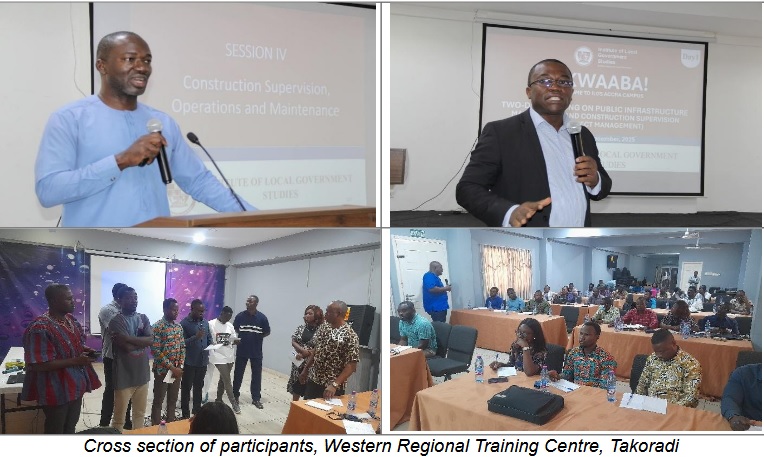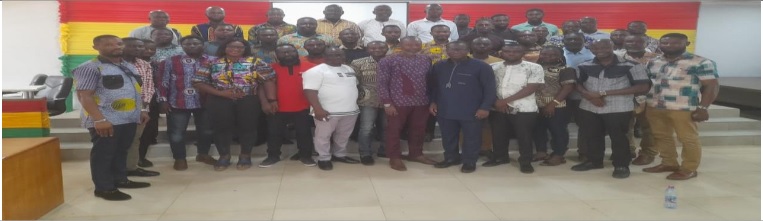
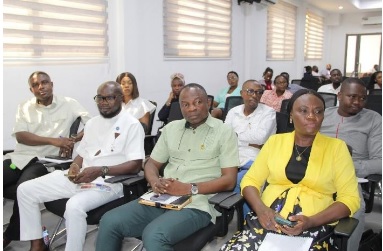
On the 18th and 19th December 2025, the Institute of Local Government Studies (ILGS) working in collaboration with the Ministry of Local Government, Chieftaincy and Religious Affairs
(MLGCRA) and the Office of the Head of the Local Government Service (OHLGS) wrapped up the series of generic programmes for the year, with a two-day training of trainers course on Public Infrastructure Management and Construction Supervision (Project Management). The training targeted District Planning Officers, Works Engineers, Public Procurement Officers and Environmental Health Officers across all 261 Metropolitan, Municipal and District Assemblies (MMDAs) and 16 Regional Coordinating Councils (RCCs).
The event was organised to deepen working knowledge and practice experience in the project lifecycle and management, project design and construction, contracts management, as well as operations and maintenance of projects. It also sought to provide clarity on the requirements for accountability, and the delivery of value-for-money infrastructure at the local level.
Resource persons drawn from specialized fields at the regional and national level, were responsible for the facilitation and delivery of the training sessions. They included project management specialists, civil engineers and architects as well as quantity surveyors within the local government sector. The modules covered in the training of trainers included, Introduction to Projects Management; the Public Infrastructure Management Framework; Procurement and Contracts Management; Construction Supervision, Operations and Maintenance; Environmental, Social, Health and Safety in Project Management; and Project Risk Management and Compliance.
An integral part of the course that captured the attention of participants was the opportunity to couch district-based change-making projects. Indeed, this aspect of the course was featured in previous training events, however, that of project management was approached differently. Participants treated the project with all seriousness as they were eager to practically demonstrate application of the knowledge, skills and attitudes learnt, when they return to their respective districts. Participants in the Change Making Project were afforded the opportunity to select an issue from their LG jurisdiction and present how they would deal with reoccurring management challenges in the area of projects management. Among the issues selected included public works delivery standards, infrastructure services planning and participatory approaches, contracts and projects management and building positive relationships with staff and superiors among others.
Based on the insights from the group presentations, it was evident that delivering quality publi c infrastructure at the local level requires a structured and disciplined approach to project governance, for which participants were clear in their minds on the imperatives. The two-day training of trainers programme empowered participants to promote a learning culture where they would be able to transfer the requisite skills and knowledge acquired at the training to their colleagues in the office. This should help address the perennial problems associated with construction supervision and project management including, risk management, compliance monitoring and evaluation, as well as to ensure sustainability and foster collaboration and accountability across project teams at the local level.